
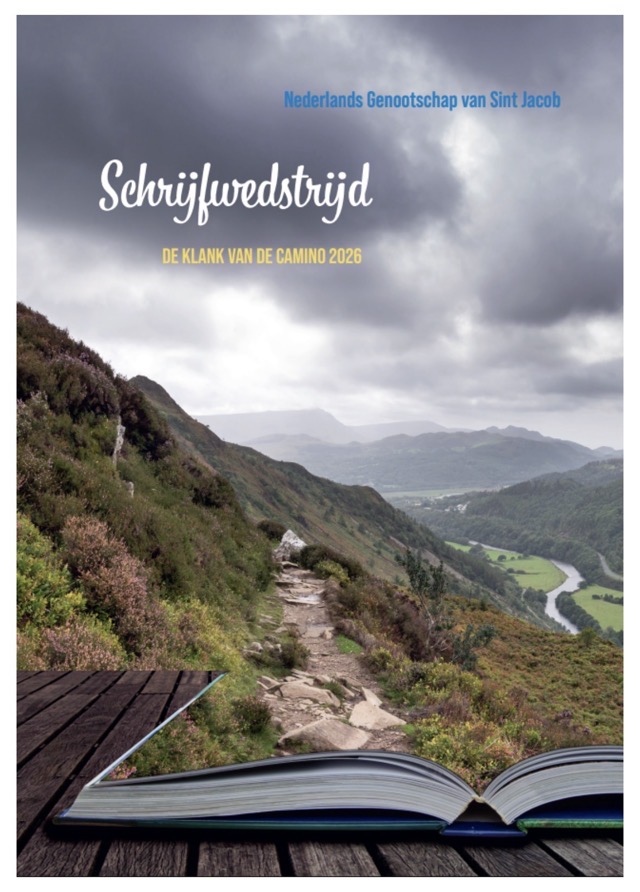
On the occasion of the 40th anniversary of the Dutch Society of Saint James, there was a writing competition. Through the website, interested individuals were invited to write a story of up to 2000 words on the theme of the anniversary: “The sound of the camino.” A professional jury of eight people initially selected nineteen stories for the longlist and then five stories for the shortlist. From this shortlist, the top five were determined. I submitted two stories, of which the one below was selected for the longlist and published in an e-book that is available for free download. This was my first time participating in a writing competition. So it’s quite nice that this is the result. Feedback is welcome!
The pitch-black sky frightens me. In the distance, I can already hear the thunder. On this lonely open plain, I have no shelter and I am an easy target for lightning. I don’t quite know what to do. Why didn’t I read up better on how to deal with these kinds of circumstances? I think I’ll always escape the danger, but that’s foolish. A disaster can happen to me too. In the distance, I see the first flash of lightning. My heart pounds in my throat. It’s coming closer quickly. It’s in God’s hands, flashes through my mind. A strange thought, as I am not religious and even have an aversion to religions.
There isn’t much I can do now. When it’s my time, it’s my time. Just hoping that He’s in a good mood towards me. The sky is brightening. The rain is pounding on the path. My shoes are soaked, my wet hair is stuck to my face. My fear has vanished. I just let it happen. When it’s time, it’s time. A series of bangs rolls through the air, I feel it buzzing in my body. A strange feeling of peace takes hold of me. It is what it is. When it’s over, it’s over. How I can feel happy now is a mystery, but that’s just how it is.
On the other side of the hill, I suddenly see a monastery emerging. I thought I still had to walk for kilometers, but it’s already there. Upon arriving at the gate, I knock. I hear nothing. I knock again. Then there’s shuffling on the other side of the door. A monk in a long robe and sandals opens up. “Welcome,” he says, “we were expecting you.” Later, the words sink in. They were expecting me? I had planned to sleep at the next inn, not in this monastery. The weather just decided differently. The monk introduces himself as Francisco and leads me to the first floor: a shared shower room and a long echoing hallway to a sparse bedroom for the night. A bed, a nightstand, a chair, and a crucifix above the headboard. This reminds me of the first time I was in Spain, as an eight-year-old boy, without knowledge of the Bible and the crucifixion of Jesus. After my mother explained to me what had happened to him and that he had nails through his hands and feet, I couldn’t sleep the entire night.
“The mass is at five o’clock,” Francisco shares. “We expect you to be on time.” He closes the door. I am left stunned. No time to say that I actually don’t need to be there. But not showing up, after this hospitality, is not an option. At five minutes to five, I make my way through the long hallways to the chapel. The prayer room is small and dark, with only a round opening in the middle of the roof. The last rays of sunlight color the statue of Mary in gold. A tear on her cheek. In her arms, the little Jesus, as if she knows what fate awaits him. Gregorian chants can be heard from behind the church benches. Eight monks in long brown robes step forward one by one. The voices resonate through the space. I have never heard anything like it. Everything is perfect. The space, the voices, the atmosphere.
The pastor walks into the church. Only goodness radiates from his face. You can see it. You can feel it. He stands behind the altar and kisses a cross. He looks around the church, gazes at me intensely and lovingly. I shyly lower my eyes. I feel caught as an atheist. He smiles gently and nods encouragingly. Then he begins his sermon. I expect complicated biblical jargon, but nothing could be further from the truth. He speaks passionately, in understandable language, about the situation in the world, your own sphere of influence, and about your own self, the ego. I hang on his every word. I could listen to this man for hours.
Suddenly, my eye catches a choir boy. He has quietly walked from the side of the church to the front and kneels before the pastor. The pastor is startled, a bit thrown off. Suddenly, it is dead silent in the church. The choir holds its breath. The believers look tense at the spectacle. I don’t understand what is happening, but I feel the tension and in one moment it’s clear to me what deafening silence is. “Get up, my boy,” whispers the pastor. He nervously fidgets with the string of his robe. The boy stands up with downcast eyes. An old woman rises from a church pew. It is still dead silent. With a bent back, she shuffles forward. Her frail body moves slowly, but once at the altar, she lashes out and strikes the boy squarely in the face with her flat hand. The sound echoes through the room. The spectators hold their breath. Without saying a word, she turns around and shuffles back. The boy doesn’t make a sound and keeps staring at the ground. The pastor reaches for his chin and lifts his face up. He looks deeply into his eyes. The boy tries to avoid his gaze but is forced to confront him. Tears fill his eyes, but the sobs remain absent. The pastor smiles: “Sit down, friend.” With his head held high, the little boy walks back to the pews. A deep breath, a sigh of relief.
The organ begins to play. The sounds reverberate through the church, deep and powerful. The congregation stands up. I follow. The priest whispers the prayer. I don’t make the sign of the cross; it feels hypocritical. Once the mass is over, everyone walks outside. I stay seated for a moment, impressed by what I have seen, heard, and felt. The priest, who had already left for the back room, softly returns. His footsteps sound muffled on the marble. He beckons me: “Come here, my son.” A feeling of warmth fills my body. Unconsciously, I knew I had to stay. There, in that church. Just as I always knew I had to walk this Camino. I often wondered: why this path, and not a hut trek in Tyrol? Here’s why: for the encounter with this man. The priest is silent. So am I. The silence says everything. A language everyone understands, transcending every religion. It moves me, and the priest is not indifferent to it either.
After a few minutes, he breaks the silence: “I am Padre Antonio, but call me whatever you wish, whatever feels good to you. I would like to invite you to dinner with me tonight.” “I would gladly accept, Padre Antonio,” I stammer. I can’t find the words, I only feel that this is a gift from God. I chuckle to myself: a gift from God for this atheist.
When I sit down at the table with Padre Antonio two hours later, it has already grown dark. The room is lit only by candlelight, and the housekeeper is serving the soup. Padre Antonio thanks her and offers a short prayer. “Enjoy your meal,” he says, looking at me with amusement. He seems to have a private joke. I start laughing too. Then Padre Antonio bursts out laughing. It’s contagious; I nearly choke on my soup. Tears of laughter roll down his cheeks. “You know,” he says, “we take life way too seriously. You must be wondering: what are you doing in a monastery?” He laughs again, winks, slaps his hands on his knees, and guffaws: “No way, man, it’s just carnival here, every day!” I look at him in surprise. “Carnival?” He nods. “Yes, amigo, what do you see?” I look at his robe, at the rope around his waist. “This,” he says, “is just a costume.” He looks at me intently. “And you? What are you wearing?” I want to reply, wiggle my toes in my hiking shoes, and place my hand on my zip-off pants, smiling. He grins too. “Exactly, that.”
Antonio downs the last bit of soup and grabs a bottle of wine from under the table. “Here’s to what we’re drinking.” He raises his glass. “To the carnival?” I ask shyly. “Isn’t that a bit hypocritical?” Padre Antonio looks at me seriously, nods, and pauses for a moment. “You could see it that way, amigo mío, my father once thought I should go into the monastery and yes, at that age I complied, I had no choice and yes, it’s one big masquerade here, but that’s really not what it’s about. Ultimately it’s about the same: goodness, love, and repentance.” The silence in the dining room is only broken by the clinking of cutlery against plates. “But what are you still doing here, Antonio?” I ask after a long silence. “Don’t you think that’s hypocritical?” “It was my family,” Antonio says without a trace of bitterness. “They believed this was my path, so I started on it and well, then you’re in it. I’ve stayed here because I can make an impact from this place. I have people in my charge who listen to me. I don’t want to call them ‘followers,’ Jesus never wanted that either, but I can give them something.”
He takes another bottle of wine from under the table. “And now we toast, buen camino, amigo, to the game we’re playing!” Our glasses clink together. The sound resonates for a moment. We drink.
Discover more from FOOTSTEPS OF FREEDOM
Subscribe to get the latest posts sent to your email.

